
Welcome to Mattanu
It is our wish as the Kriek family that you have a great stay with us and if there is anything that we can do to enhance your experience please feel free to ask. Also familiarize yourself with the information supplied pertaining to your stay with us.
As a family run business our aim at Mattanu is to give you an unique experience and personal attention as we enjoy building relationships with our guests. We would love to have you return in future so if there is anything which is not up to standard, please let us know so we can correct it and improve for your comfort. Dr Kriek was awarded the Wildlife Ranching of South Africa Game Rancher of the year award for 2009 and we encourage you to question and become involved as much as you please in the management of our animals and the reserve.
We are very proud to inform our visitors that we have also won the annual AA accommodation award for best small (7 Rooms or less) Game/ Nature Reserve in South Africa for 2011 and Lilizela awards for best Game Lodge in the Northern Cape for 2014-2016. We realize that without your support this could not be possible so thank you very much for choosing Mattanu for your break away.
Have a great stay
The Story Behind
Mattanu
Mattanu is a Hebrew phrase meaning, “gift from above”. This is the underlying factor why we want to share Gods creation with everybody.
This 4 700 ha (11 614 acres) Game Reserve, owned by the Kriek family, started in 1991 when the owner, Dr JC Kriek, originally from Zimbabwe, imported 95 endangered Roan antelope and 65 rare Sable antelope species into South Africa from Malawi.
This is regarded by many as the most successful Game capturing and importation operation ever. Dr JC Kriek is also regarded by many as the pioneer for the breeding of endangered antelope industry in Southern Africa. Ever since then more than 300 Roan, Sable and Disease free Buffalo have been bred at Mattanu. Dr JC Kriek, in conjuction with Dr Fred Potgieter, also wrote the protocol for the breeding of disease free Buffalo and fittingly was the first private game rancher to receive permission for the breeding of these Buffalo.
The profit returns from the Malawi operation was used to purchase Mattanu Private Game Reserve, which was then a cattle farm, in 1990 and to date many millions have been spent in the development of the infrastructure and the reintroduction of numerous species. To date there are over 36 different animal species and approximately 700 animals on Mattanu.
The Northern Cape is a very dry province and therefore not many diseases exist in this province. This is one of the main reasons why most of the animals breed so well and why the conservation of all our species are so positive. This is all worthwhile as Mattanu Private Game Reserve is not only a Game Ranch or a business, but a dream being realized and a passion of the whole Kriek family.
The breeding and distribution of endangered and rare antelope species is the main industry at Mattanu along with the game capture and immobilization by Dr JC Kriek.
We also realise that without sustainable utilisation of older animals for the hunting market, our passion for the conservation of these species may not be economically viable thus, although the hunting is a small part of our business, it is essential as part of the value chain and the green economy of SA.
The Family at
Mattanu
Dr Johan Kriek, wildlife veterinarian and until recently, commercial helicopter pilot, moved to SA in 1980 from Zimbabwe.
Started a mixed veterinary practise and soon after started importing wildlife from Africa to realise his dream of one day owning his own game farm. He imported Tsessebe from Zimbabwe in 1984, Roan, Sable and Lichtenstein Hartebeest from Malawi in 1987 and 1991 and Livingstone Eland from Zimbabwe in 1994.
In 1991 this dream was realised and the breeding of rare Roan and Sable antelope started, soon followed by the first private disease free Buffalo breeding project. His wife, Daleen Kriek, a qualified Physiotherapist assisted from the small vet practise days, through all the wildlife importation operations until now where she is still very much involved in the hospitality of Mattanu Private Game Reserve. Their eldest son Johann Kriek was born in 1980, followed by Jacques Kriek in 1982 and daughter Heleen Kriek in 1986. Son Johann qualified as an IT technician during 2001 and developed the Kriek Helicopters & Kriek Wildlife websites with electronic marketing platforms. He obtained his commercial helicopter license during 2006 & was instrumental in the certification of Kriek Helicopters as a commercial helicopter service. Jacques finished his degree in Tourism management/marketing and development and in 2006 actively started developing and marketing the breeding farm as a eco tourism destination evolving into the award winning Mattanu Private Game Reserve. He now also chairs the WRSA Roan and Sable advisory committee. Sister Heleen, qualified somatologist, is in the process of establishing a wellness spa at Mattanu. The whole Kriek Family also qualified as estate agents with Daleen and Johan being the principals. Along with their sons, under the Kriek Wildlife Group brand, they now specialise in the game breeding/capture/immobilisation, translocation, marketing of wildlife/farms as well as consulting and mentoring current and future game breeders. As professional hunters Dr Johan, Johann and Jacques also assists with all trophy and biltong hunts at Mattanu.
They were recently joined by son-in-law, Burger Schoeman, whom will further diversify the KWG into the meat production industry.
Other family members include Johann’s wife, Dominique, with children Tiaan and Mine as well as Jacques’s wife, Stephné, with son Stephan and daughter Jané.
Burger is also involved in all facets of the KWG with main responsibilities being the farm management, maintenance and labour relations. Heleen and Burger also became parents in 2017 with the newest addition of grandchildren being their son Pierre.

Left to right, Back row: Dr Johan Kriek, Johann Kriek, Jacques Kriek and Burger Schoeman
Middle row: Daleen Kriek, Dominique Kriek, Stephné Kriek with Jané Kriek and Heleen Schoeman
Front row: Miné, Tiaan en Stephan
Room
Directory
Activities at Mattanu to be booked at the lodge
- Game drives by guided vehicles (No self-drives)
- Helicopter game viewing flights
- Helicopter fly-fishing trips (Book in advance)
- Helicopter tours to Diamond mines, Vaalriver, Irrigation schemes, Spitskop dam with flamingos, Big Hole tour and Ox Wagon trail flights.
- Dinners in the bush
- Massages in the spa room
- Quad biking safaris
- Game capture safaris (Book in advance)
- Un-guided Walking at own peril.
- Airstrip available for fly in trips
Water
The water at Mattanu is from a borehole and runs through filters for additional purification so it is completely safe for human consumption. Bottled water is available on request. Please use water sparingly as the Northern Cape is a semi-arid area and thus water is a very valuable resource.
Wifi
Guests have access to free wifi of 100mb/day. Registration and additional wifi data may be purchased at the lodge reception.
Smoking areas
Mattanu is a non-smoking area with no smoking in any buildings or on any game viewing vehicles. Smoking is permitted outside the tents on the decks, main lodge veranda or lapa area. Please refrain from discarding cigarette butts into the bush or ground as ashtrays are supplied.
Activities in a 100km radius outside Mattanu
Please let management know if you plan to leave Mattanu at any time as gates will be locked for security.
- Kimberley Big Hole
- Honour Dead Memorial
- Flamingos at Kamfersdam
- Flamingo Casino in Kimberley
- Ghost tours in old Kimberley
- Diamond mine tours
- Wildebeeste Kuil art centre
- Magersfontein Battle fields
- Magersfontein Memorial Golf Club
- Kimberley Golf Club
- Star of the west pub
- Halfway House Hotel and Pub
- William Humphreys Art Gallery
- McGregor Museum
- Finesse Beauty Clinic
- Kalahari Lodge Restaurant
- GWK Rugby Stadium
- De Beers Diamond Oval cricket ground
- Various gyms, squash / tennis courts, bowls, archery and shooting ranges etc
- Diamond Pavilion shopping Centre
- North Cape mall
- Pizza King Putt Putt course
- Big Hole Driving range
Tour Guides can be arranged if needed
Times
- Morning Game Drives: Winter 09h00 Summer – 08h00
- Afternoon Game drives: Winter/Autumn – 16h00 Summer / Spring – 17h00
- Buffet breakfast follows the morning Game Drive
- Dinner will be served from 18h30 in winter and from 19h30 in summer.
- Dress code at the lodge is casual during the day and smart casual during the evenings.
- Gates will close at 18h00 unless arranged otherwise.
- A cash bar will be available from breakfast until dinner.
Valuables
Valuables can be stored in your electronic mini-safe under your bar fridge. To program the safe press the red button behind the door while door is open; the yellow light will come on and give a short beep. Please input the user code from 3-8 digits using any within 30 seconds. Then press “E” to confirm. To open input the user code you programmed followed by the “E”, the green light will come on and you can turn the know within 5 seconds to open.
NB! Please leave safe open upon departure if it was used
Laundry service
Laundry service is available and a fee and laundry bags may be requested at the lodge.
List
Animal List
Roan
HIPPOTRAGUS EQUINUS
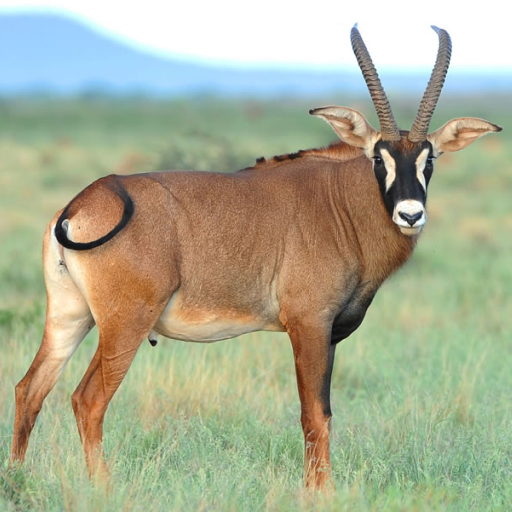
Identification: Second largest antelope. Both sexes are horned. Grey brown in Colour. Very long ears with a tussle of hair on the end. Dark face with a white patch on each side of the face stretching from the base of the horn downwards to the side of the face, around the nose, both lips, chin and throat are white. They have a mane as well as long hair on the lower neck.
Size: Shoulder height ± 140cm. Weight ± 270kg.
Habits: Live in groups of up to 30. They live in the same area for years. Not very aggressive but has territorial behavior. They are grazers and prefer medium to long grass. A dominant cow will always be on watch at the side of the herd. Calves are born any time of the year.
Distribution: Southern parts of North Africa, Angola, Congo, Tanzania, Zambia, Malawi, Mozambique, Zimbabwe, Northern Namibia and South Africa.
Sable
HIPPOTRAGUS NIGER
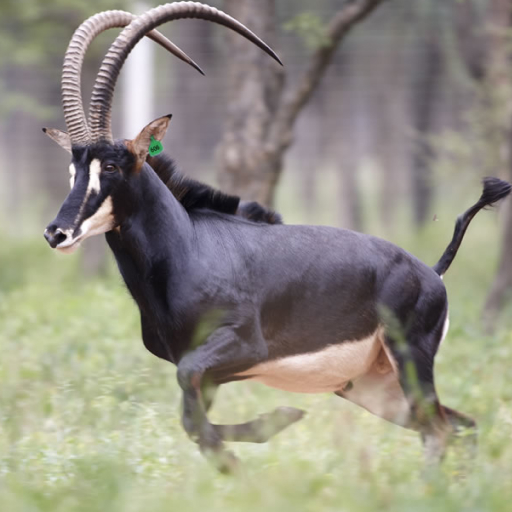
Identification: Bulls are black and cows are mainly brown but occasionally black. Vertical white lines on the face, white tummy, white inner thighs and buttocks. Both sexes have horns.
Size: Shoulder height 135cm. Weight – 230kg.
Habits: Groups of up to 200. Territorial. They sometimes fight to death to protect territories. There is one or two dominant cows in a herd. They always lead the herd to water and pastures and when danger approaches. They graze in the mornings and afternoons and rest in the shade during midday. They are selective grazers and prefer grass of medium length. Calve from January to March.
Distribution: Kenya, Tanzania, Malawi, Zambia, Zimbabwe, Mozambique, Botswana, South Africa.
Red Hartebeest
ALCLAPHUS BUSELAPHUS
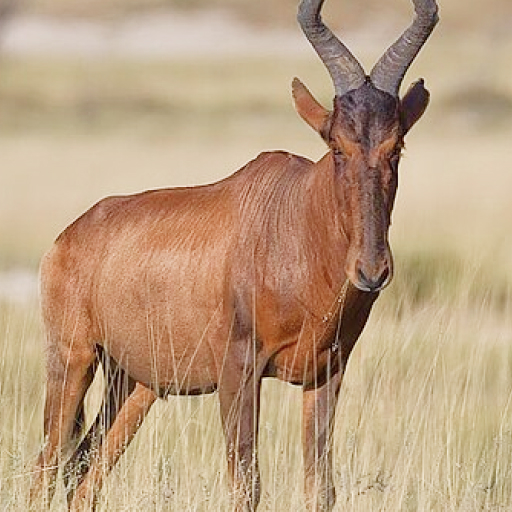
Identification: Dark reddish brown in colour, sloping back, long thin, black face. Horns are on a pedestal base and point backwards. Tummy and inside of thighs are cream in colour. There are dark areas stretching from the shoulders down to the hoofs. Lateral sides of front and hind limbs are mainly black.
Size: Shoulder height ±1,25m; weight 120 – 150kg.
Habits: Group animals 20-300. Territorial, they have a gland just under the eye for marking of territories. Sense of smell and hearing very well developed. Graze during the day. They can run very fast. Calves start to graze at 2 weeks of age. Calving season – October and November.
Distribution: Namibia, Botswana, Northern Cape and also a small part of Central Africa.
Buffalo
SYNCERUS CAFFER
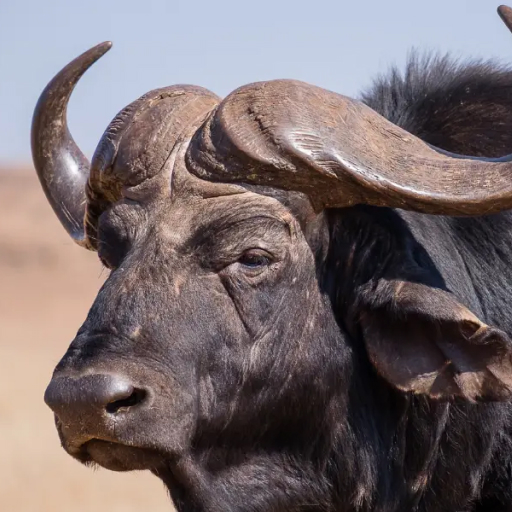
Identification: Large ruminants looking very much like cattle. They are heavily built and bulls are black, cows have reddish brown tint with the black. Bulls have heavy horns with well developed “Boss”. Cows horns are much lighter, they have broad muscle and large ears situated behind the eyes.
Size: Mass 750-800kg. Shoulder height – 140cm.
Habits: Move around in large family units of up to 3000 in a group. Old bulls normally group together in bachelor groups, in the dryer season they tend to graze near water. Non-selective grazers, also browse a bit. Buffalo are carriers of foot and mouth and corridor disease. Puberty at three years. Gestation 330-346 days ± 11 months. Birth weight – 40kg. High mortality amongst calves.
Distribution: Central and Southern Africa.
Gemsbok
ORYX GAZELLA
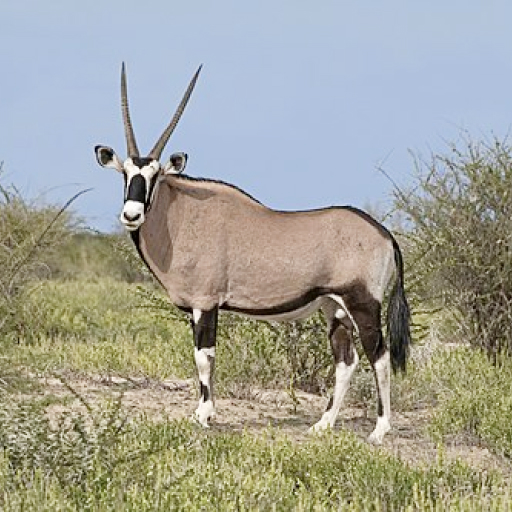
Identification: Long straight horns in males and females. Light grey in colour with typical black markings and a black horse-like tail. Short black mane, black in colour continuing onto the tail. Black and white face markings. Lower parts of legs are white. Both sexes have horns.
Size: Shoulder height ± 1,2m. Weight 210 – 240kg.
Habits: Grazers but browse occasionally. Love dry open areas (semi-desert). They also eat tsammas and roots. Calves are born throughout the year. They are very well adapted for hot conditions and have a well-developed cooling-off system for the blood going to the brain.
Distribution: Ethiopia, Somalia, Sudan, Uganda, Kenya, Tanzania, Angola, Namibia, Botswana, Western Zimbabwe and South Africa (Northern Cape).
Golden Gemsbok
ORYX GAZELLA

Identification: A colour variation to the normal Gemsbok species producing this unique colour when bred in a seperate herd of animals all carrying the gene. Bulls and cows have similar markings to the normal oryx however all the black has been replaced with a golden colour and the white turns into a light beige colour. The majority of Golden Oryx originate from Namibia.
Size: Shoulder height 135cm. Weight – 230kg.
Habits: Groups of up to 200. Territorial. They sometimes fight to death to protect territories. There is one or two dominant cows in a herd. They always lead the herd to water and pastures and when danger approaches. They graze in the mornings and afternoons and rest in the shade during midday. They are selective grazers and prefer grass of medium length. Calve from January to March.
Distribution: Namibia, South Africa and may occur in some parts of Botswana.
Royal/Red Oryx
ORYX GAZELLA
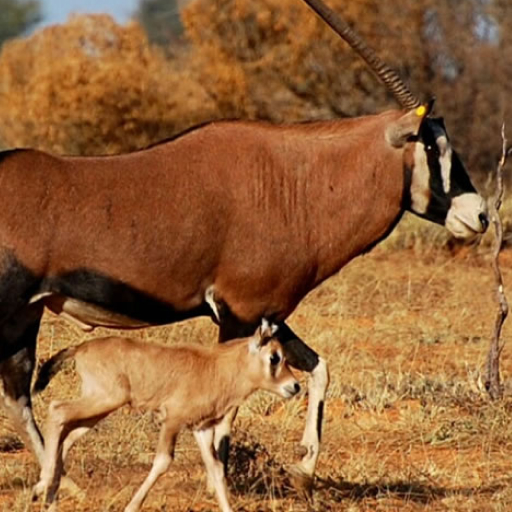
Identification: A colour variation to the normal Gemsbok species producing this unique colour when bred in a seperate herd of animals all carrying the gene. Bulls and cows have similar facial features to the normal oryx but the white on the whole body is replaced white a rich deep red terracotta colour making this one of the most beautiful colour variations in the Oryx family.
Size: Shoulder height 135cm. Weight – 230kg.
Habits: Groups of up to 200. Territorial. They sometimes fight to death to protect territories. There is one or two dominant cows in a herd. They always lead the herd to water and pastures and when danger approaches. They graze in the mornings and afternoons and rest in the shade during midday. They are selective grazers and prefer grass of medium length. Calve from January to March.
Distribution: Namibia, South Africa and may occur in some parts of Botswana.
Saddle Back Oryx
ORYX GAZELLA

Identification: A colour variation to the normal Gemsbok species producing this unique colour when bred in a seperate herd of animals all carrying the gene. Bulls and cows look similar to normal Oryx except for the back, rear, rump and sides which turns completely black in winter and a slightly lighter shade of black in summer. Both sexes have horns.
Size: Shoulder height 135cm. Weight – 230kg.
Habits: Groups of up to 200. Territorial. They sometimes fight to death to protect territories. There is one or two dominant cows in a herd. They always lead the herd to water and pastures and when danger approaches. They graze in the mornings and afternoons and rest in the shade during midday. They are selective grazers and prefer grass of medium length. Calve from January to March.
Distribution: Namibia, South Africa and may occur in some parts of Botswana.
Giraffe
GIRAFFA CAMELOPARDALIS
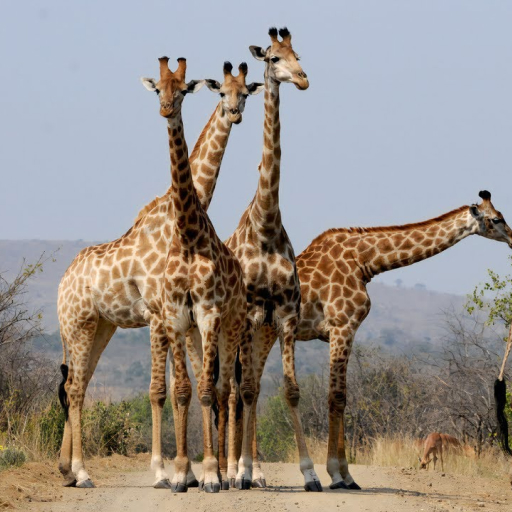
Identification: Tallest animal on earth with very long legs, covered with brown irregular patches with two hornlike structures on the head. Patches tend to darken with age. Face without patches.
Size: Height 4,3 – 5,2m. Weight 828 – 1200kg.
Habits: More active during daytime. Rest during the day in a standing position or lying in sternal recumbence with neck upright. Giraffes have a peculiar gate, hind and foreleg of one side moving forward together. Max speed: ± 56km/h. Gestation period: 460 (15 months) days, babies weigh ± 102kg at birth. Fighting between bulls is done with neck swaying and bumping. They are mainly browsers.
Distribution: Patchy distribution in Western, Eastern and Southern Africa.
Livingstone Eland
TAUROTTTTRAGUS ORYX
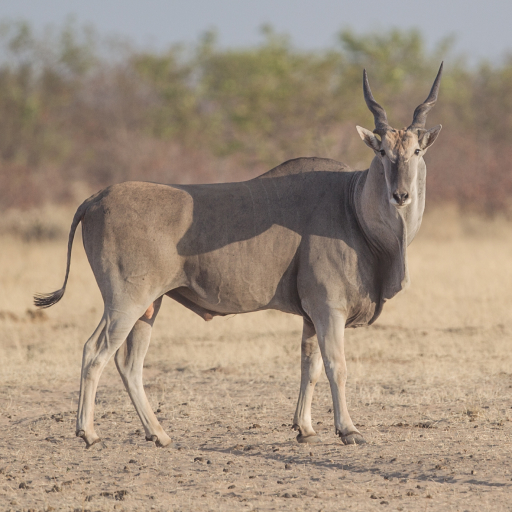
Identification: Dark tanned colour with white stripes down the sides varying from only a few to 16 stripes. Very characteristic white chevron on the nose with black hairline on the tummy and black stripes behind the elbows and knees.
Size: Shoulder height 1,5 – 1,7m. Weight 460 – 1000kg.
Habits: Live in groups of up to 1000. Mainly browsers but do occasionally graze, they love wild fruit. Well adapted for dry hot climate. Not territorial. Bulls can be aggressive towards each other. Calves are born mainly from August to November.
Distribution: Kenya, Tanzania, Zambia, Angola, Namibia, Malawi, Botswana, Zimbabwe, Mozambique and South Africa.
Tsessebe
DAMALISCUS LUNATUS
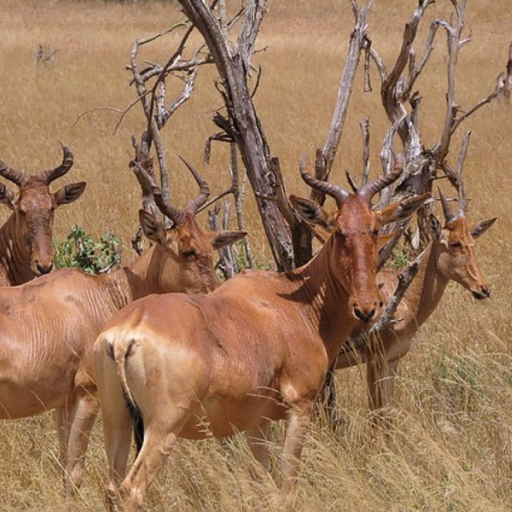
Identification: Colour is dark reddish brown with noticeable purple shade changing to almost black from the top of the head to the tip of the nose. The shoulders, upper parts of front and back legs and thighs are almost black. The distal parts of the legs are yellow brown. In Central Africa a subspecies of Tsessebe is found known as the Topi.
Size: Shoulder height 1,2m; weight – 126-140kg.
Habits: Graze in groups during the day, they prefer long grass of ± 60cm. Territorial behavior. They have pre-orbital glands for marking of territories. Calving season October to December.
Distribution: Botswana, Namibia, Zimbabwe and South Africa.
Waterbuck
KOBUS ELLIPSIPRYMNUS
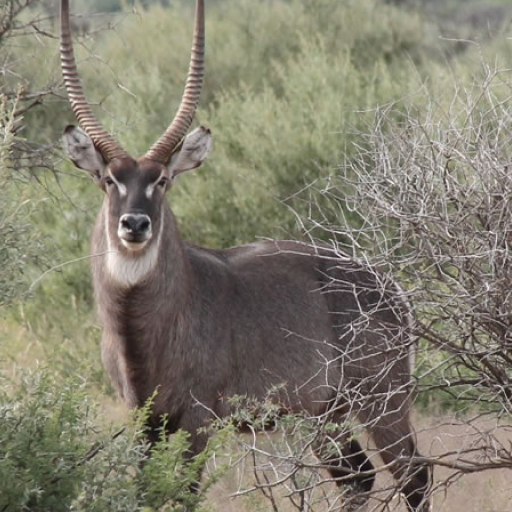
Identification: Brown-grey in colour. Typical white ring around the tail. Face is darker with white lines on the inner sides of the eyes. Chin is white and there is a white collar around the throat. Also a white ring just above the hooves. Horns – males.
Size: Shoulder height 1,7m. Weight 250 – 270kg.
Habits: Groups of 6-12. Territorial. Grazers but browse occasionally. Calf throughout the year. Twins are born occasionally.
Distribution: Somalia, Kenya, Tanzania, Malawi, Zambia, Mozambique, Zimbabwe, Northern Transvaal, parts of natal.
Springbok
ANTIDORCAS MARSUPIALIS

Identification: Medium sized antelope, both sexes have horns. Smaller in female. Cinnamon colour on the back with a dark red brown band on the side. The tummy, inside of legs, buttocks and faces are white. Tip of the tail is black. There is a black line from the eye to the corner of the mouth. You also get black or white springbok.
Size: Shoulder height 75cm; weight 37-41kg.
Habits: Graze in groups. Territorial. They are very hardy and even do well in semi-desert areas. They also eat leaves. They groom themselves with their teeth and hind hooves. They can run up to 88km/h. When frightened – they give long high jumps, then change to a gallop before they trot away. When they run away the tail is curled up tightly against the back. Lambs are born mainly during summer.
Distribution: Namibia, Botswana and the Northern Cape in South Africa.
Burchell’s Zebra
EQUIS BURCHELLI
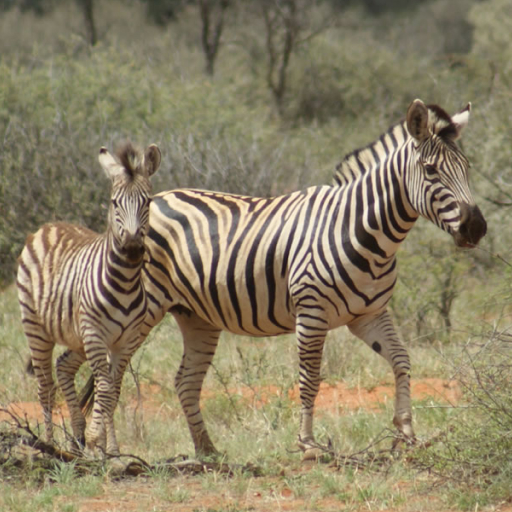
Identification: No two individuals have the same markings on the body. Shadow stripes between the black stripes, on the hindquarters only, are characteristic of this species. Zebra are always in a good condition. Ears are rounded.
Size: Shoulder height 136cm. Weight – ± 320kg.
Habits: Non-selective grazers, will browse occasionally. Gestation period 360-390 days (± 12 months). Birth weight 30-35kg. Live in family groups, fairly dependant on water thus always within 10 km thereof.
Distribution: Open savanna area. Eastern and Southern Africa.
Kudu
TRAGELAPHUS STREPSICEROS

Identification: They are grey brown in colour with 6-10 vertical white stripes on the body. They have a white V on the nose just under the eyes with white lips and chin. The mane is also partly white. The bulls have corkscrew-shaped horns. They have big ears. Bulls have a dark beard that stretches down to the front of the chest.
Size: Shoulder height – 1,25 – 1,4m. Weight – 200 – 250kg.
Habits: Live in groups of 4-12. Mainly browsers, non-selective. Mainly active at dusk and dawn. Kudu are gracious. They jump high and are very shy. They give a loud bark when frightened and run away with the horns held horizontal and the tail curled up to show the white underneath. Calves are born mainly from January to April.
Distribution: Eastern parts of Africa, Angola, Namibia, Botswana, Malawi, Zimbabwe, Mozambique, Zambia and South Africa.
Common Duiker
SYLVICAPRA GRIMMIA
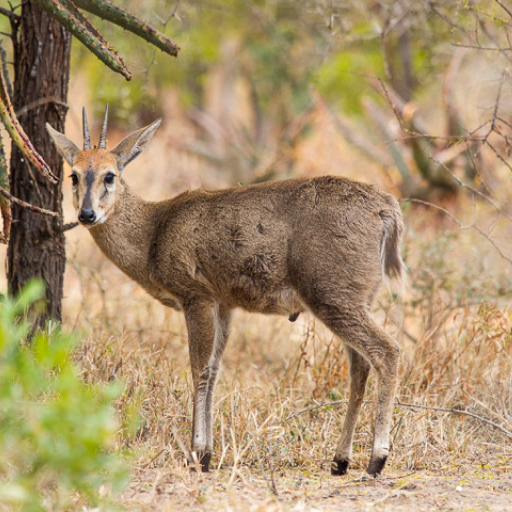
Identification: Grey white in colour. Tummy and inner sides of legs are white. On the forehead and nose is a black line. Rams have a tuft of hair between the horns. They have pre-orbital glands, foot glands and glands in the groin. Horns (males) and sometimes old females as well.
Size: Shoulder height 50-52cm; weight 15-25kg.
Habits: Mostly solitary, browse during dusk and dawn. When in danger they lie motionless in the grass and only run away when you get very near. They run very fast and are very strong. They also eat grass, roots and wild fruit. Lambs are born throughout the year.
Distribution: Central, Eastern and Southern Africa.
Blue Wildebeest
CONNOCHAETES TAURINUS
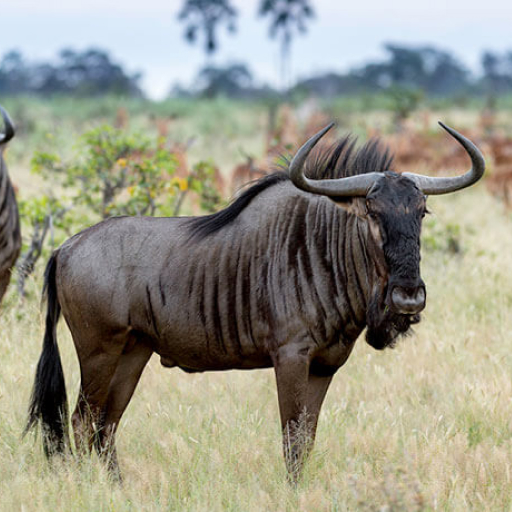
Identification: Dark grey to brown silver colour. The neck, shoulders and front half of the body have diagonal dark stripes. They have a long black mane, beard and tail tussle. The horns are smooth, broad at the base and point towards each other. The young have a reddish colour. Both sexes have horns.
Size: Shoulder height 135 – 150cm. Weight 180 – 250kg.
Habits: Territorial group animals 20-1000, active during the day but prefer shade during the hot hours of the day. They have a typical “tar” smell coming from glands on the front feet which is also used for marking of territories. Prefer to graze on short green grass. Calving season November to December.
Distribution: Angola, Botswana, Zimbabwe, Tanzania, Mozambique, South Africa.
Golden Wildebeest
CONNOCHAETES TAURINUS
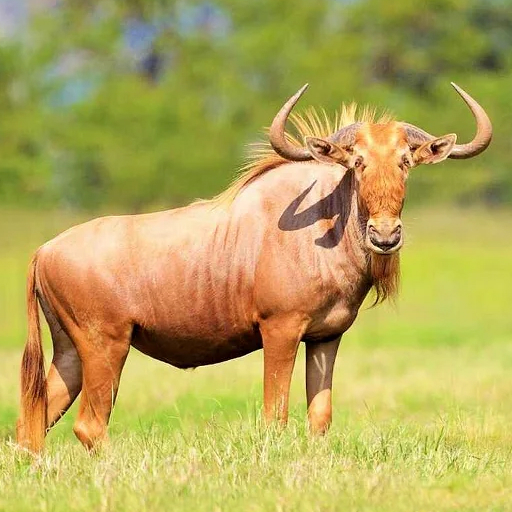
Identification: The whole animal is golden – copper in colour because of a ressesive gene and colour is bred frequently when animals carrying the golden gene is kept in the same herd.
Size: Shoulder height 135 – 150cm. Weight 180 – 250kg.
Habits: Territorial group animals 20-1000, active during the day but prefer shade during the hot hours of the day. They have a typical “tar” smell coming from glands on the front feet which is also used for marking of territories. Prefer to graze on short green grass. Calving season November to December.
Distribution: Angola, Botswana, Zimbabwe, Tanzania, Mozambique, South Africa.
Steenbok
RAPHICERUS CAMPESTRIS
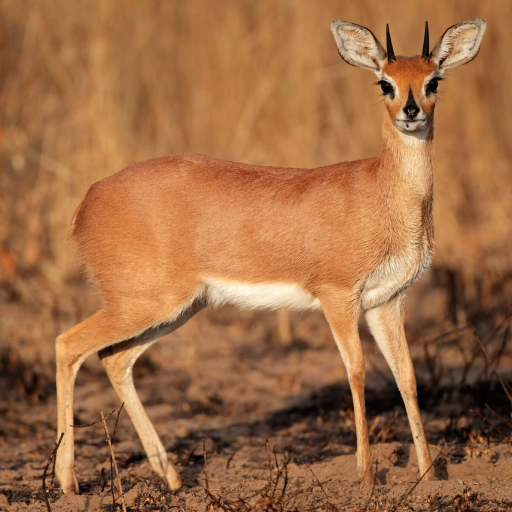
Identification: Small, gracious antelope with thin legs. Reddish brown in colour. White underneath, nose is pointed, forehead has a dark Y-shape mark on it. Horns male. The tail is the same colour as the body.
Size: Shoulder height 52cm. Weight 11-11,3kg.
Habits: Solitary. Browse and graze at dusk and dawn. Territorial. They use their pre-orbital, hoof and throat glands for marking of territories. When in danger they hide motionless in the grass. Lambs are born throughout the year.
Distribution: Southern Africa, Tanzania and adjacent coastal area.
Saddleback Impala
AEPYCEROS MELAMPUS
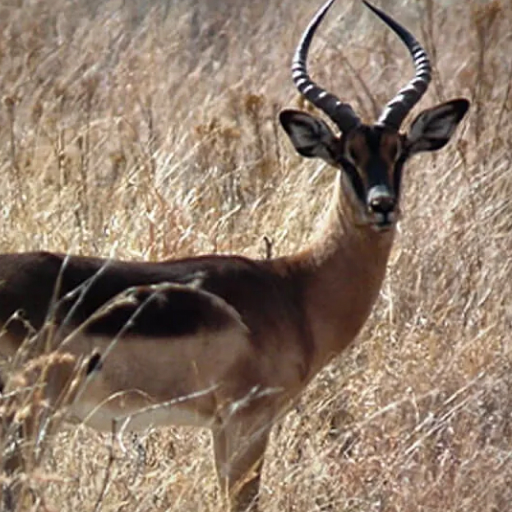
Genetic mutation Identification: Very gracious and beautiful. The top halve of the animal is black along with the face and front legs whilst the rest of the body is the same as the normal impala. A very unique and rare colour variation. Horns males.
Size: Shoulder height 90cm. Weight 40-50kg.
Habits: In groups of 15-100. Territorial behavior. Active during the day. They are very agile and jump very high and far (+/- 12m) when frightened. They also graze from time to time. Lamb from September to January.
Distribution: Western Angola, Tanzania, Kenya, Zambia, Zimbabwe, Botswana, Malawi, Mozambique and South Africa.
Impala
AEPYCEROS MELAMPUS
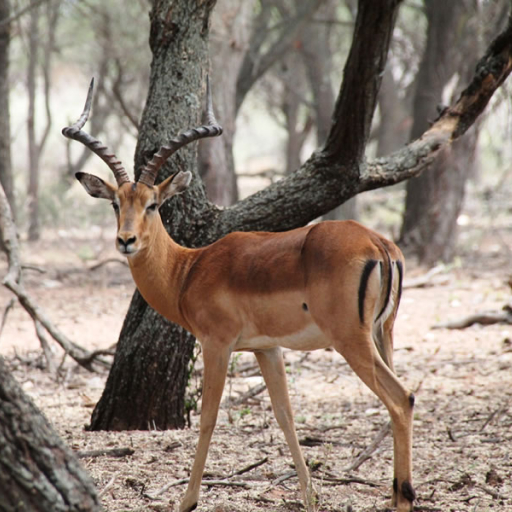
Identification: Very gracious and beautiful. Red brown in colour. Sides and shoulders are lighter. Tummy is pure white. Also white spots above the eyes. Just above the hind fetlock joint a distinct black tussle of hair can be seen. The tail is black with two diagonal black stripes, on the buttocks on either sides of the tail. The tail is white underneath. Horns males.
Size: Shoulder height 90cm. Weight 40-50kg.
Habits: In groups of 15-100. Territorial behavior. Active during the day. They are very agile and jump very high and far (± 12m) when frightened. They also graze from time to time. Lamb from September to January.
Distribution: Western Angola, Tanzania, Kenya, Zambia, Zimbabwe, Botswana, Malawi, Mozambique and South Africa.
Black Impala
AEPYCEROS MELAMPUS
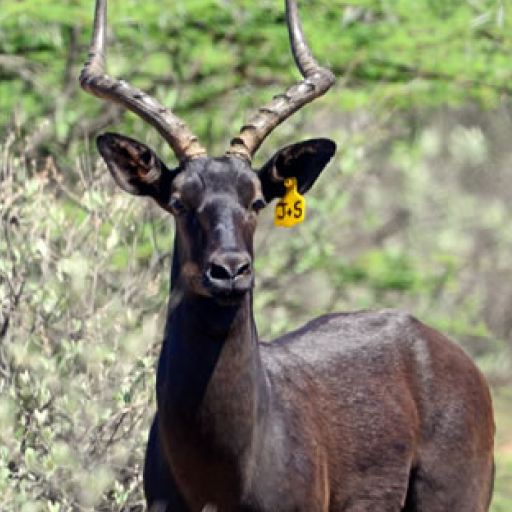
Genetic mutation Identification: Very gracious and beautiful. Completely black in colour. Just above the hind fetlock joint a distinct black tussle of hair can be seen. Horns males.
Size: Shoulder height 90cm. Weight 40-50kg.
Habits: In groups of 15-100. Territorial behavior. Active during the day. They are very agile and jump very high and far (+/- 12m) when frightened. They also graze from time to time. Lamb from September to January.
Distribution: Western Angola, Tanzania, Kenya, Zambia, Zimbabwe, Botswana, Malawi, Mozambique and South Africa.
Aardwolf
PROTELES CRISTATA
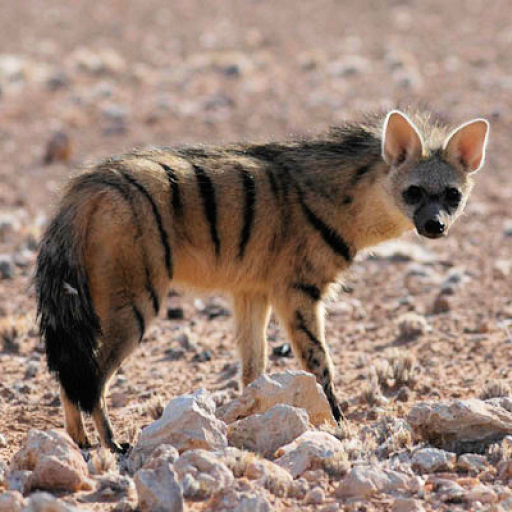
Identification: Its name means “earth wolf ” in Afrikaans. The aardwolf resembles a very thin striped hyena, but with a more slender muzzle, black vertical stripes on a coat of yellowish fur, and a long, distinct mane down the midline of the neck and back. It also has one or two diagonal stripes down the fore- and hind-quarters, along with several stripes on its legs. The mane is raised during confrontations to make the aardwolf appear larger. It is missing the throat spot that others in the family have. Its lower leg (from the knee down) is all black, and its tail is bushy with a black tip.
Size: Weight 7-10kg. Shoulder height 40-50cm.
Habits: The aardwolf is a small, insectivorous mammal. It does not hunt large animals. It eats insects, mainly termites – one aardwolf can eat about 250,000 termites during a single night, using its long, sticky tongue to capture them. It is nocturnal, resting in burrows during the day and emerging at night to seek food.
Distribution: East and Southern Africa.
Warthog
PHACOCHOERUS AETHIOPICUS
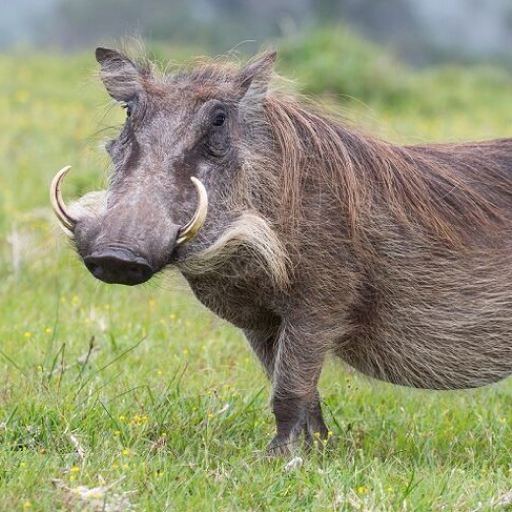
Identification: Grey colour. Thin short legs. Mane in both sexes stretching from between the ears to the long tail. Mane and tail stand upright when scared. Tail has a tuft of black hair on the tip. They have elongated heads with protruding eyes and warts on the side of the face. Boars have two large pairs. Warthog have enormous canine teeth curling over the snout.
Size: Weight 70-100kg. Shoulder height 70cm.
Habits: Warthog are active during the day and hide in holes at night. They love rolling in mud. Move around in family groups of 5-10. Territories are marked with urine and the secretion of the gland just under the eye. They eat plants, grass, roots and wild fruit.
Gestation: 165-175 days ± 3 piglets born, puberty 18-19 months.
Distribution: Western, central, eastern and southern Africa.
Bat-Eared Fox
OTOCYON MEGALOTIS
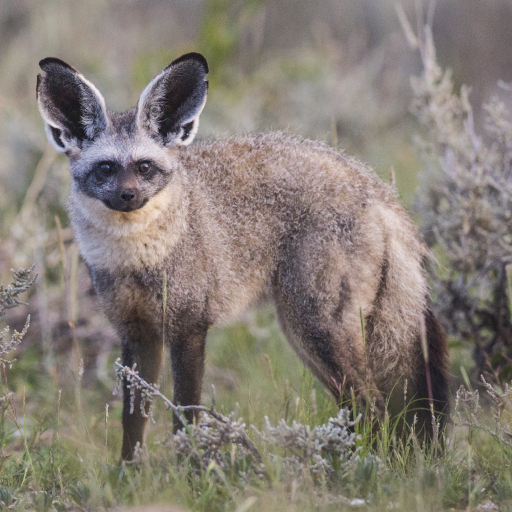
Identification: They have typical, huge ears. Colour is light grey-brown. The fur is thick and soft, the forehead and inside of ears are white, chin, lips and limbs are black.
Size: Weight max 5kg. Length 80cm.
Habits: Day and night living. They dig their own holes or modify other holes to meet their needs, have a good sense of hearing which assists in finding food. They are very playful, toiletry habits are located to one area. Live in family groups. Diet consists of termites, insects, mice, grasshoppers, reptiles and wild berries.
Distribution: Eastern and Southern Africa.
Ant bear Aardvark
ORYCTEROPUS AFER
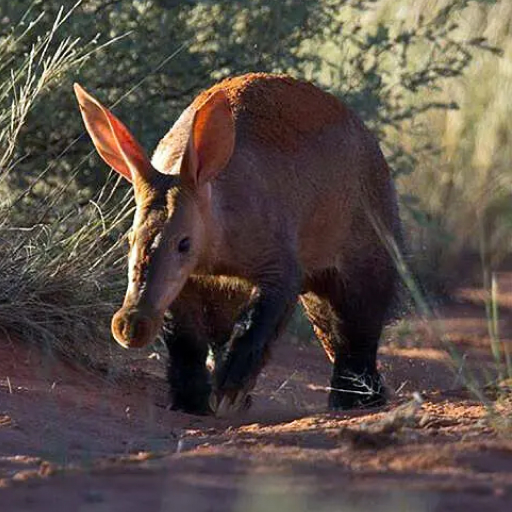
Identification: Long snout and long ears, light yellow-grey colour with very thin hair coat like swine. Hindquarters much heavier than
front quarters. They have thick pointed tails with big, strong feet, four toes on the front feet and five toes at the back.
Size: 40-53,3kg.
Habits: Solitary and nocturnal. Prefer sandy soil areas for easier digging. They like ant heaps, eyesight bad but sense of smell and hearing well developed. Ant bear are powerful diggers. Diet consists of ants and termites. Gestation: 7months. 1-2 little ones born 1,8kg.
Distribution: South of the Sahara, eastern and southern Africa.
Smith’s Red Rock Rabbit
PRONOLAGUS RUPESTRUS

Identification: Red brown in colour with black speckles. Darker spot on the back of the neck.
Size: Length 40-45cm. Weight 1,3 – 2,05kg.
Habits: Nocturnal. They eat grass and have 1-2 babies at a time. They live in rocky areas.
Distribution: South Africa, Malawi, Zambia and Tanzania
Caracal
CARACAL

Identification: Colour is yellowish red and ears are pointed with tufts of black hair at the ends.
Size: ± 18kg in weight and ± 45cm high.
Habits: Nocturnal, solitary and prey on birds, small antelope (Duiker), reptiles, rabbits and springhare. Gives birth to a litter of 2-4.
Distribution: Africa and parts of Europe – Israel, Syria, Jordan, Iraq and Iran.
Porcupine
HYSTRIX AFRICAEAUSTRALIS
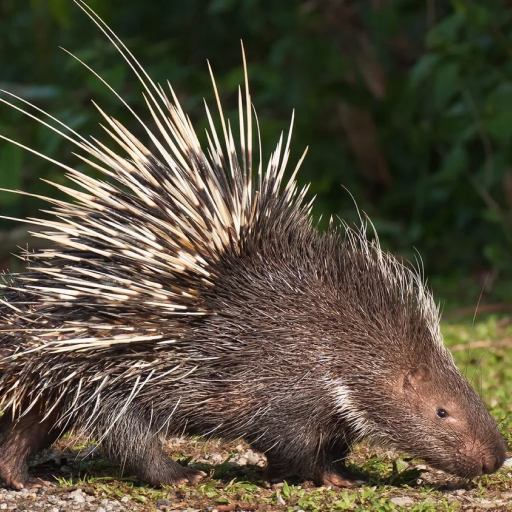
Identification: Biggest rodent, protected by an Armour of long, sharp quills on the back and sides. Quills are white with black rings and vary from 30-50cm in length. The rest of the body is covered in coarse black hair. Thinner quills form a mane from the head to the shoulders.
Size: 10-18kg.
Habits: Solitary-sometimes in pairs, nocturnal. 3-4 Adults live together in the same shelter but split up when searching for food. Good sense of hearing, good swimmers, aggressive when confronted – attack backwards with upright quills. Diet is vegetarian and they have the habit of chewing bones. Babies are born with soft quills which harden quickly.
Distribution: Southern half of Africa.
Suricate (Meerkat)
SURICATA SURICATTA

Identification: Siver-brown, broad head with short, pointed nose, thin sharp tail. Hindquarters better developed than forequarters. They all have dark patches around the eyes but the eyes are relatively small, the ears are small and dark and the front claws are well- developed for digging.
Size: Length 50cm; weight 720-960gram.
Habits: Day living and love sunbathing, always very alert. They dig their own holes, live in colonies of up to 20. diet consists of worms, lizards, eggs and small snakes.
Distribution: South-West Angola and Southern Africa.
Large Spotted Genet
GENETTA TIGRINA

Identification: Short legs, long body, white rings around the tail with a black distal part. Chin is always white, limbs are light in colour.
Size: Weight 1,4-2,3kg.
Habits: Nocturnal. Live in holes in the ground and in trees. It can jump very far and are good climbers. Diet consists of rat, mice, beetles, grasshoppers and birds.
Distribution: Eastern part of Southern Africa.
Striped Polecat
ICTONYX STRIATUS
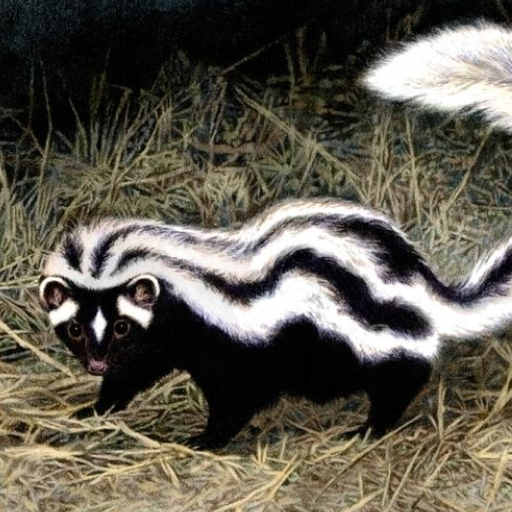
Identification: Black body with four parallel white stripes, from the head to the base of the tail, is very distinct. Tail is white and the limbs black. When confronted they spray a foul smelling liquid from their anal glands.
Size: eight 6-10kg.
Habits: Solitary and nocturnal. Seek shelter in holes dug by other species. Aggressive but tame easily, in an emergency situation they pretend to be dead until the danger disappears. Diet consists of birds, mice, insects, spiders, scorpions and reptiles.
Distribution: Whole of Africa south of the Sahara – except in the Tropical Forest in Western Africa.
Black Backed Jackal
CANIS MESOMELAS

Identification: Colour is rusty red with a dark brown and silver grey- saddle. The head is dog-like with a sharp nose and pointed ears. The lips and chest are white. Distal parts of limbs are lighter than the rest of the body.
Size: Weight 7-8kg. Shoulder height 38cm.
Habits: Day and night living, walk alone or in pairs or in groups of up to 30 especially when feeding. They have a good sense of smell, they always trot except when hunting when they usually walk slowly. They are shy and sly, both males and females protect their territory. Diet consists of carrion, rabbits, insects, reptiles, mice and snakes. They have a typical howl at night.
Distribution: East Africa and southern Africa.
Baboon
PAPIO URSINUS

Identification: Dark brown, black face and hands. The proximal 1/3 of the long tail is carried upright and the distal 2/3 hangs down. The well developed calluses, under the tail, of female baboons are separated where as in males they are joined. Eyes situated very close together, baboons have a excellent eyesight.
Size: Males 32kg, females 15kg.
Habits: Group animals, up to 100. Home range 13-23km2. Well developed rank structure with larger males keeping watch. Sleep on cliffs or in high trees. They eat a wide variety of plants, insects and meat. Puberty 4-6 years. Gestation – 6 months, one baby born.
Distribution: Southern Africa.
Slender Mongoose
CALERELLA SANGUINEA

Identification: Small, short legs, slender with a long, black tipped tail. Colour is reddish brown.
Size: Weight 370-790 gram.
Habits: Solitary or in groups, moves around during the day, in sunny, hot conditions. Diet consists of grasshoppers, termites, beetles and ants. Also lizards, mice, birds, wild fruit, snakes, frogs and worms. It can also climb trees.
Distribution: Central, Eastern and most areas of South Africa.
Yellow Mongoose
CYNICTIS PENICILLATA
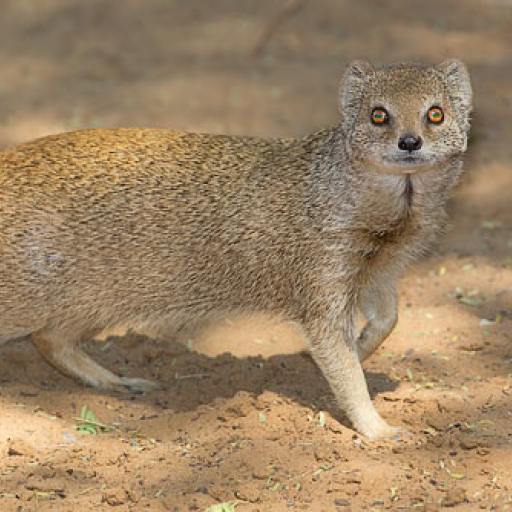
Identification: Yellow to yellow-grey in colour and has a bushy tail with a white end.
Size: Weight 829-900 gram.
Habits: Move around during the day, occasionally seen at night. Live in colonies of 10-50. Diet consists of ants, termites, small birds, grasshoppers, reptiles and seeds.
Distribution: Namibia, Botswana and most parts of South Africa.
Small-Spotted Genet
GENETTA GENETTA

Identification: Short legs; long body. Tail has got white rings around and is the same length as the body plus the head. The body has a black dorsal stripe from behind the ears to the base of the tail. The background colour of the hair is white to yellow. Two distinct black stripes run from the inside of the ears down to the front of the shoulders. The spots on the rest of the body are arranged in rows from front to back. Front legs are very dark, eyes have a white spot underneath. Cheeks and chin are black.
Size: Weight 1,6-2,6kg.
Habits: Nocturnal. Mostly solitary, are good climbers but prefer walking on the ground. Diet consists of small rodents, reptiles, insects, birds and rabbits.
Distribution: South of the Sahara, East Africa and Southern Africa (not in Central Africa).
Cape Hare
LEPUS CAPENSIS
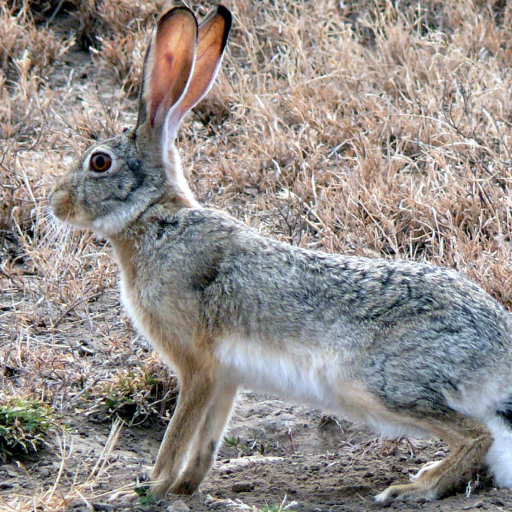
Identification: Dark grey and yellow spotted in colour. Tummy is white, feet are yellow to white, ears are shorter than the scrub Hare, rounded with hair around the edges.
Size: Length 49-65cm. Weight: 1,6-3,5kg.
Habits: They love open areas. Also found in desert and semi-desert areas. Hides in the grass. Feed on grass. Nocturnal. They have 1-2 babies at a time.
Distribution: Round the northern coast of Africa, East Africa, parts of Botswana, Mozambique and western parts of South Africa.
Spring Hare
PEDETES CAPENSIS
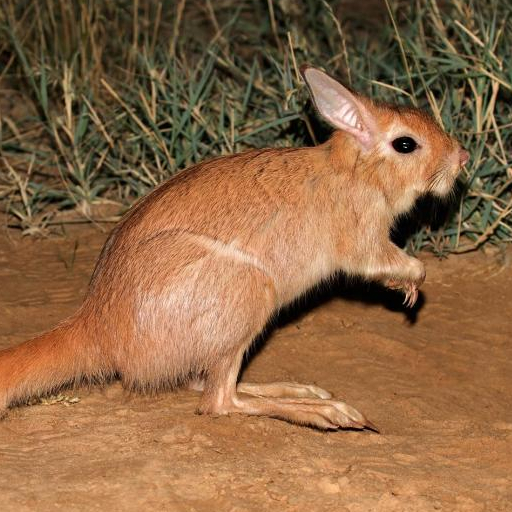
Identification: Short front legs and large, very strong hind legs. Long tail with a black distal half. Small, round head with big eyes and long thin ears (with rounded tips) looks a bit like a mini kangaroo, tail is a mechanism for balance.
Size: Length 90cm; weight 3,1kg.
Habits: Nocturnal. When chased they can jump up to 2m at a time. They live in groups and have no territorial behavior. They dig holes to live in and stay underground during rain and very cold nights. Diet consists mainly of grass and roots.
Distribution: Namibia, Zimbabwe, South Africa and eastern Africa.
Ground Squirrel
XERUS INAURIS
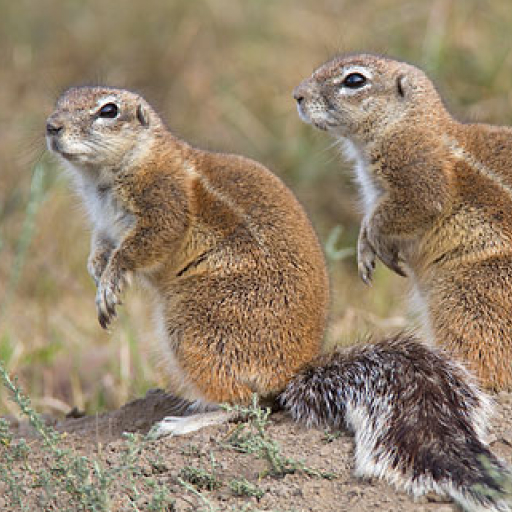
Identification: Ground living, bushy tail is often jerked up towards the head. Cinnamon colour with lighter tummies. Typical white side stripes, they have got white rings around the eyes, they have no external ears.
Size: Weight 500-800gram. Habits: Day living, live in colonies of up to 30. Love sunbathing and sand bathing, always alert, certain birds are part of their alarm system. Diet consists of leaves, grass, seeds, will occasionally eat insects.
Distribution: Southern Africa.